- Lazy Leverage
- Posts
- Why You Should Pay Employees to Sit and Do Nothing
Why You Should Pay Employees to Sit and Do Nothing

Jon Matzner
December 19, 2025
We made something a little different for Christmas to say thank you for a wonderful year, check it out!
Now to business!
Frank sat in his office.
Dispatch board? Booked solid for three weeks.
Revenue? FLAT.
Like every trade business owner, Frank blamed recruiting. "I just need more plumbers," he told himself. Find another master tech or two and everything gets fixed.
Bullllllllshiiiiiiiiiit.
Frank had five master plumbers. FIVE. And he was still broke.
His problem wasn't hiring.
It was his brain.
Frank decided to stop viewing his business as a collection of busy workers.
Instead? A FACTORY.
One with five big, slow, expensive machines in the middle.
Those machines were his master plumbers—Mike, Danny, Luis, Ray, and Kevin.
Five guys who could do things nobody else could do.
Five guys who were also….and Frank hated admitting this….kind of prima donnas about it.
They were the constraint. The entire company's revenue was capped by how many water heaters (swap water heaters for any complex plumbing task. I don't know. I'm not a plumber) those five guys could install in a day.
Everything else?
Noise.
Step 1: Find the pile
Frank looked for the queue.
It wasn't in the warehouse. It wasn't in the inbox.
The pile was the three-week wait list of customers who needed complex work that only his master plumbers could do.
Five guys. One bottleneck.
Every minute one of them wasn't turning a wrench was revenue gone forever.
Not delayed. GONE.
Poof. Bye-bye. That money is buying someone else a boat.
Step 2: Exploit the constraint
Frank watched the morning routine.
His master plumbers spent the first hour loading their own trucks. Organizing fittings. Answering emails on their iPads. Shooting the shit in the parking lot. Talking about the freaking Cowboys.
Five guys. Five hours of lost productivity. EVERY. SINGLE. DAY.
That's 25 hours a week of his most expensive talent doing grunt work.
Frank wanted to scream.
He implemented what he called the fighter pilot mentality.
Does the pilot change his own tires? Nope.
Does the fighter ace cook his own food? Hell no.
So why were his master plumbers loading their own vans like rookies?
Loading the trucks: Having master plumbers load their vans was like having surgeons mop the operating room.
Dumb.
Dumber than buying a small business with 90% PGd debt and zero experience, because a entrepornagrapher on the internet told you it was a good idea.
Moving forward, Frank assigned apprentices to load every truck before the guys arrived. The “machines”start producing the moment they show up. No coffee. No chit-chat. Wrench in hand. Go.
Separating diagnosis from repair: Frank stopped sending master plumbers to diagnose simple leaks. Junior techs diagnosed problems and built pull lists. Parts got delivered to job sites. Master plumbers showed up solely to install.
Hands on tools. Nothing else.
Quality input: His guys never arrived at a home where the customer wasn't ready. Junior staffers confirmed every appointment. Made sure grandma moved her pog collection away from the water heater.
No work reached the constraints unless it was ready to be processed.
Simple stuff. Embarrassingly obvious in retrospect.
But nobody was doing it.
Step 3: Subordinate everything else
This was hard for the team to accept.
Frank told his apprentices and office staff that their efficiency no longer mattered.
Only the master plumbers' did.
He had to purposefully de-optimize everyone else.
Yeaaaaaah. That's a weird sentence. Stay with me.
Frank hired two runners…junior employees whose entire job was to sit idle until a master plumber needed a part.
When Mike realized he was missing a fitting, a runner fetched it.
Instantly. Like a golden retriever. But for pipe fittings.
"But I'm just sitting here 80% of the time," one runner complained.
Frank explained:
Availability is a precondition for speed.
You're a firefighter. You get paid to be idle so that when the alarm rings, you respond NOW.
Don't organize shelves. Don't do busy work. Don't "stay productive."
Just... be available.
The runners hated it. Felt wasteful. Their work ethic was screaming.
Too bad.
Optimizing a non-constraint is a mirage. Looks like progress. It's not. It's just movement. Movement isn't progress. Movement is masturbation.
Frank also implemented Drum-Buffer-Rope:
The Drum: The master plumbers set the pace. Period. Five guys. 100 jobs a week. That's the drumbeat. Everything else marches to it.
The Buffer: A queue of standby jobs…for example…water heater replacements where the owner wanted a discount for flexibility. If any guy finished early, work was waiting. The constraint never goes hungry or slows down... EVER.
The Rope: Dispatch stopped releasing work until the team was ready. No more shoving 200 jobs into a system that could only handle 100.
Step 4: Elevate the constraint
Only AFTER wringing every ounce of productivity out of his five master plumbers—after ensuring they did nothing but skilled plumbing for 8 hours straight—did Frank look at the numbers.
The team was completing double the work.
DOUBLE.
Same five guys. Same hours. Same trucks.
If demand still exceeded what the fully optimized team could do, THEN Frank would spend capital on a sixth master plumber.
Not before.
What actually happened
Frank didn't have a hiring problem.
He had a utilization problem.
He stopped trying to make everyone busy and focused entirely on making the constraints flow.
Eventually, throughput increased so much that the constraint moved.
His guys ran out of work. They were too damn efficient.
Now Frank had a new problem: finding more customers.
AND THAT'S EXACTLY HOW IT SHOULD WORK.
The constraint moved from Operations to Sales.
Frank smiled. Cracked a beer. Watched the sunset.
Then panicked about marketing.
This is taken from a longer podcast I did last week, all about the theory of constraints… check it out!
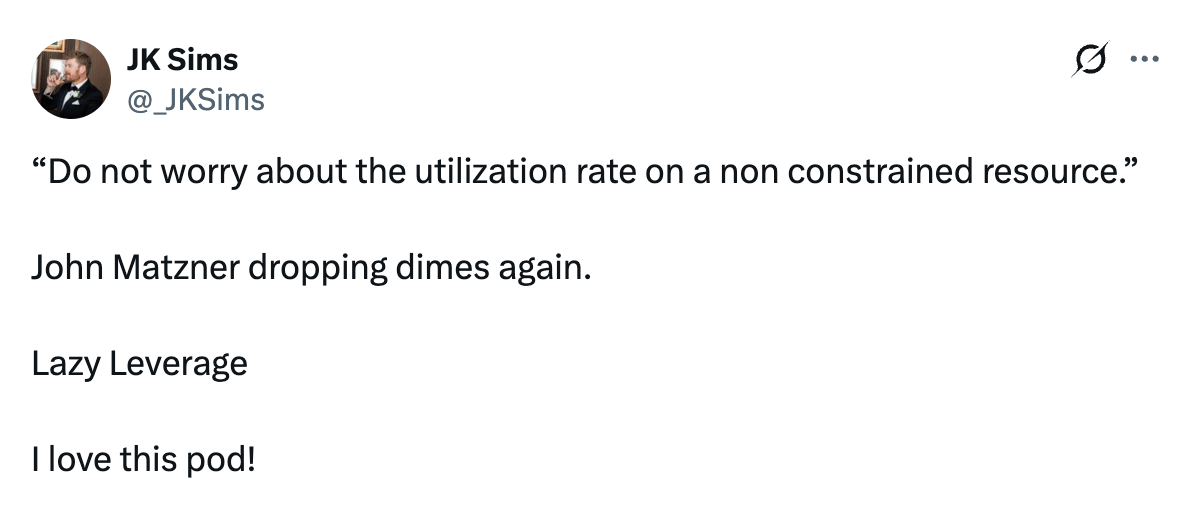
People are liking it…


Yallah habibi,
Jon